The entry door — a reference request
Sarah's former colleague needs an FCA SMCR-grade reference from her. She receives an email with a single-click magic-link to walk through the reference. No password yet, no account yet — she just verifies the facts.
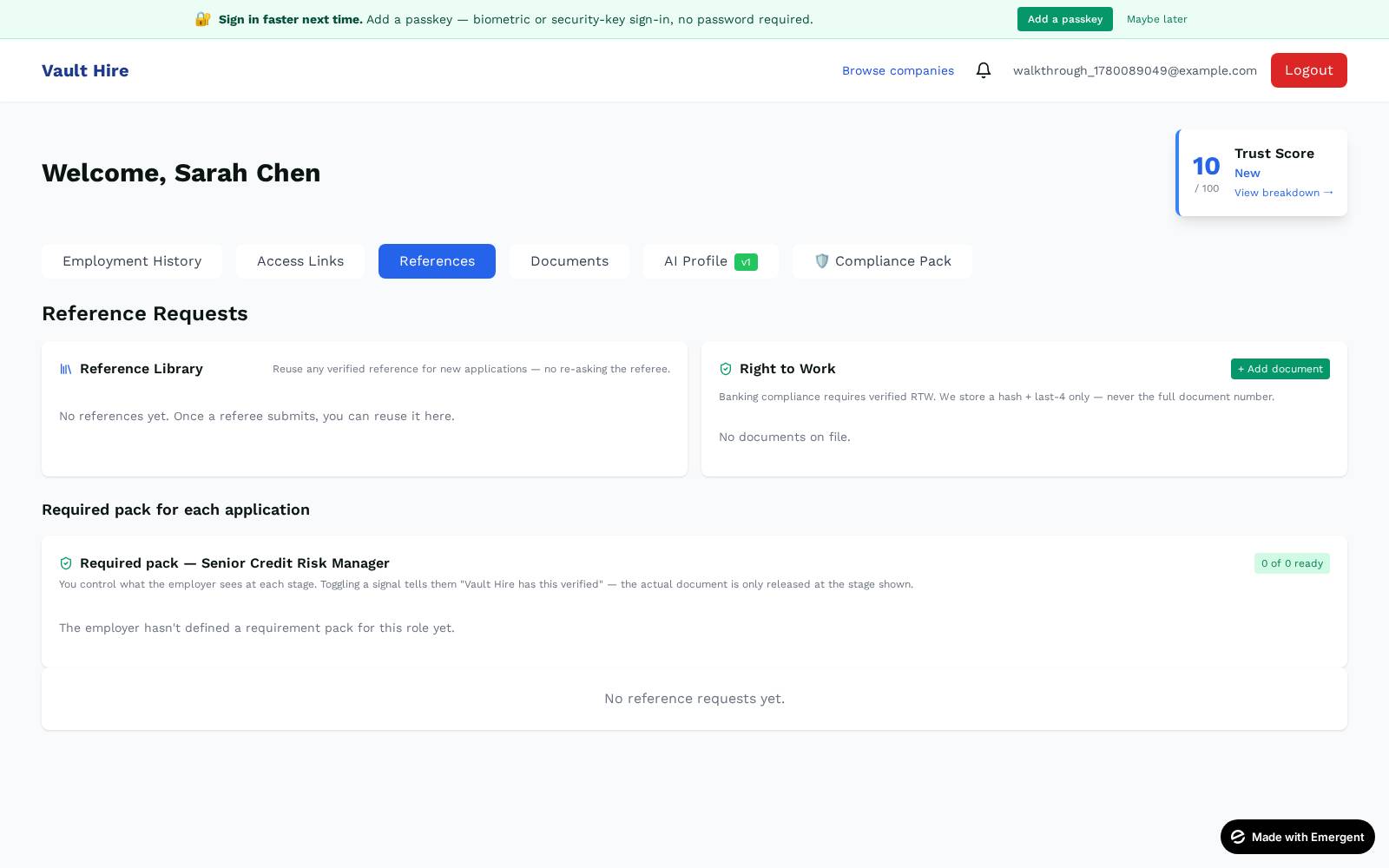
Verifying identity & employment
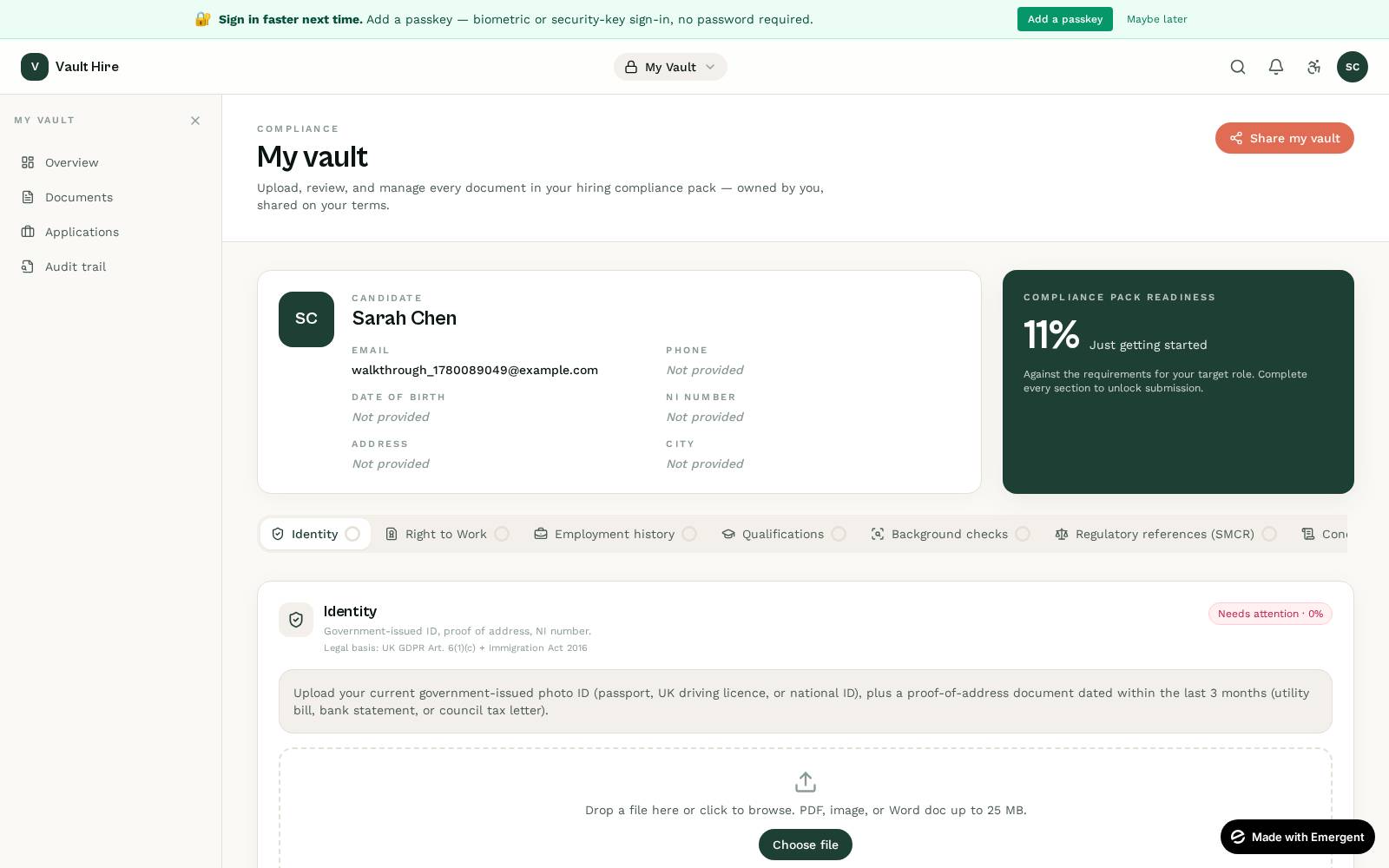
To stand by the reference she just gave, Sarah completes a light identity step (passport hash + employment-record cross-check). The same evidence underpins her own future hires — she only does it once.
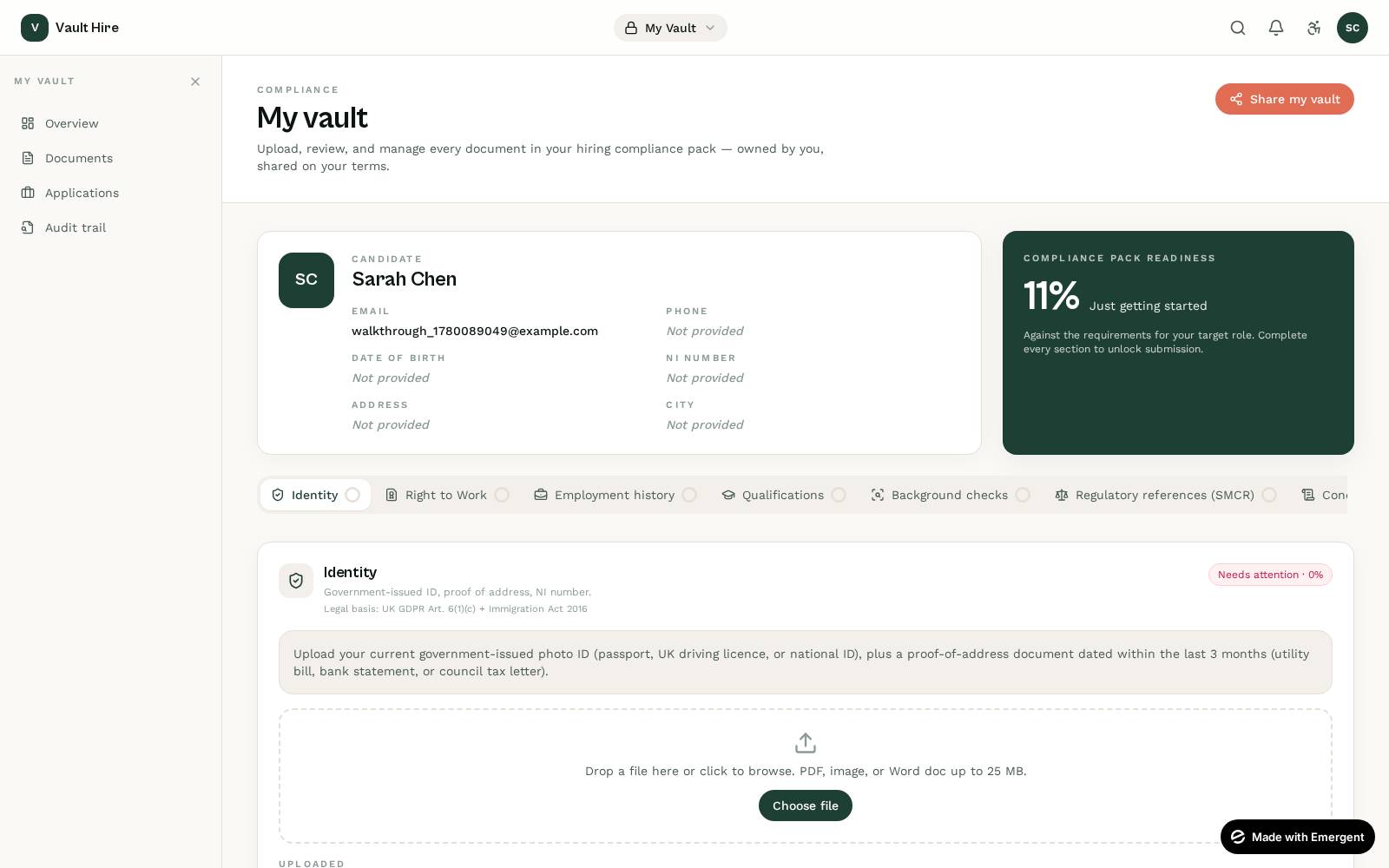
What this step does
- Identity is hashed at upload; raw documents stay encrypted.
- The employment record Sarah's colleague vouched for is now signed by Sarah and the third-party referee.
- Sarah's vault score moves from 0% to ≈ 20% — the platform shows her exactly what's still missing.
Free vault unlocked
With identity in place, Sarah is invited to open her own full vault. Free forever, with all 10 tabs, hash-chained, GDPR-exportable.
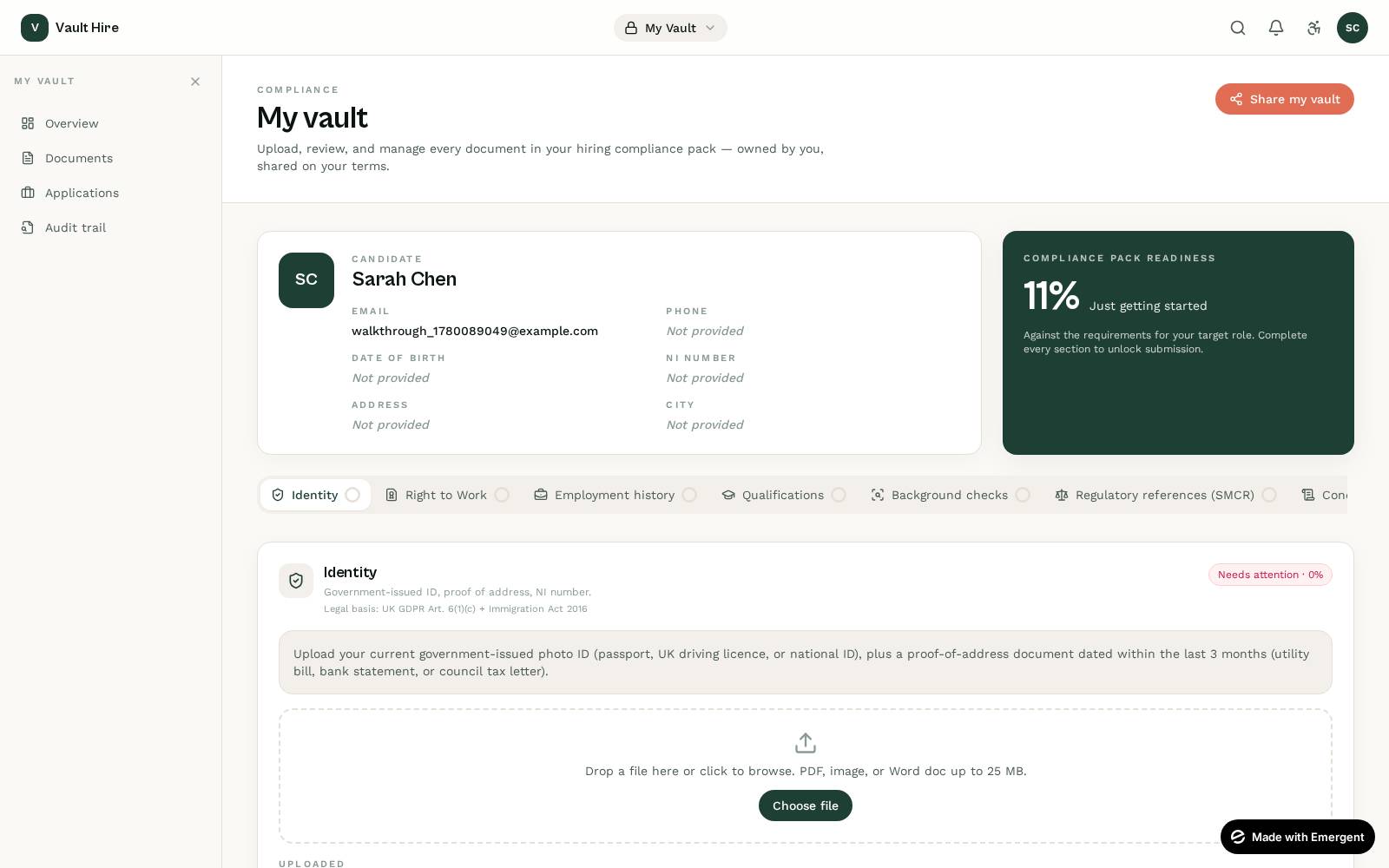
What this step does
Free tier > CV. The free vault is more useful to Sarah than a CV: it carries verified employment, hashed IDs, regulatory references, and any badges (CFA, FCA SMCR certifications). She has a reason to keep adding to it even before she's actively job-hunting.
Building the compliance pack
Sarah keeps building — Right to Work, SMCR references, background checks, qualifications. Every tab has a readiness meter at the top.
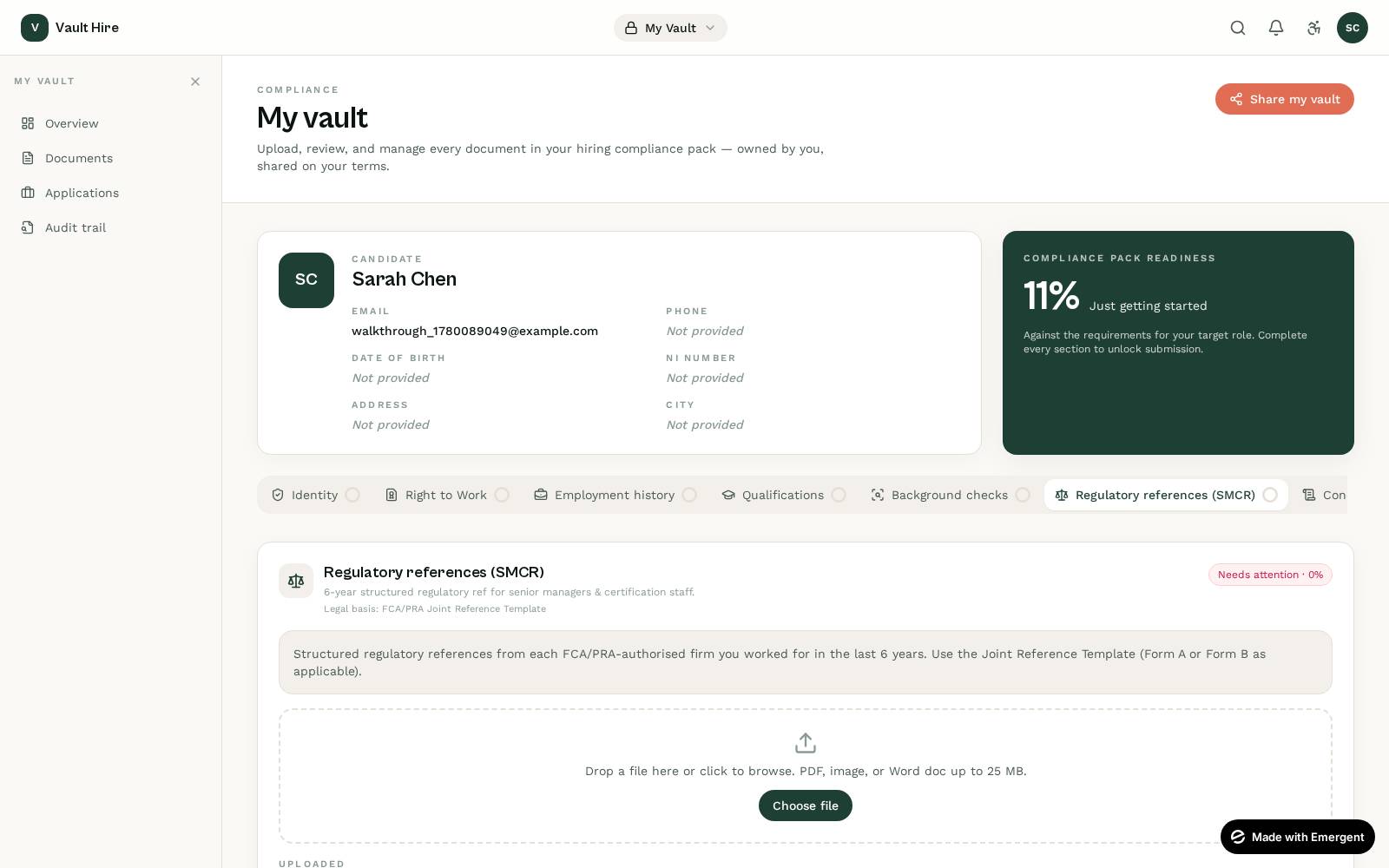
What unlocks for her as readiness grows
Once Sarah's pack readiness exceeds 70%, the platform proactively offers her additional benefits — all free: visibility to job boards she opts into, alerts on roles matching her vault profile, and earlier access to interested recruiters. The product never asks her for money.
First share & first application
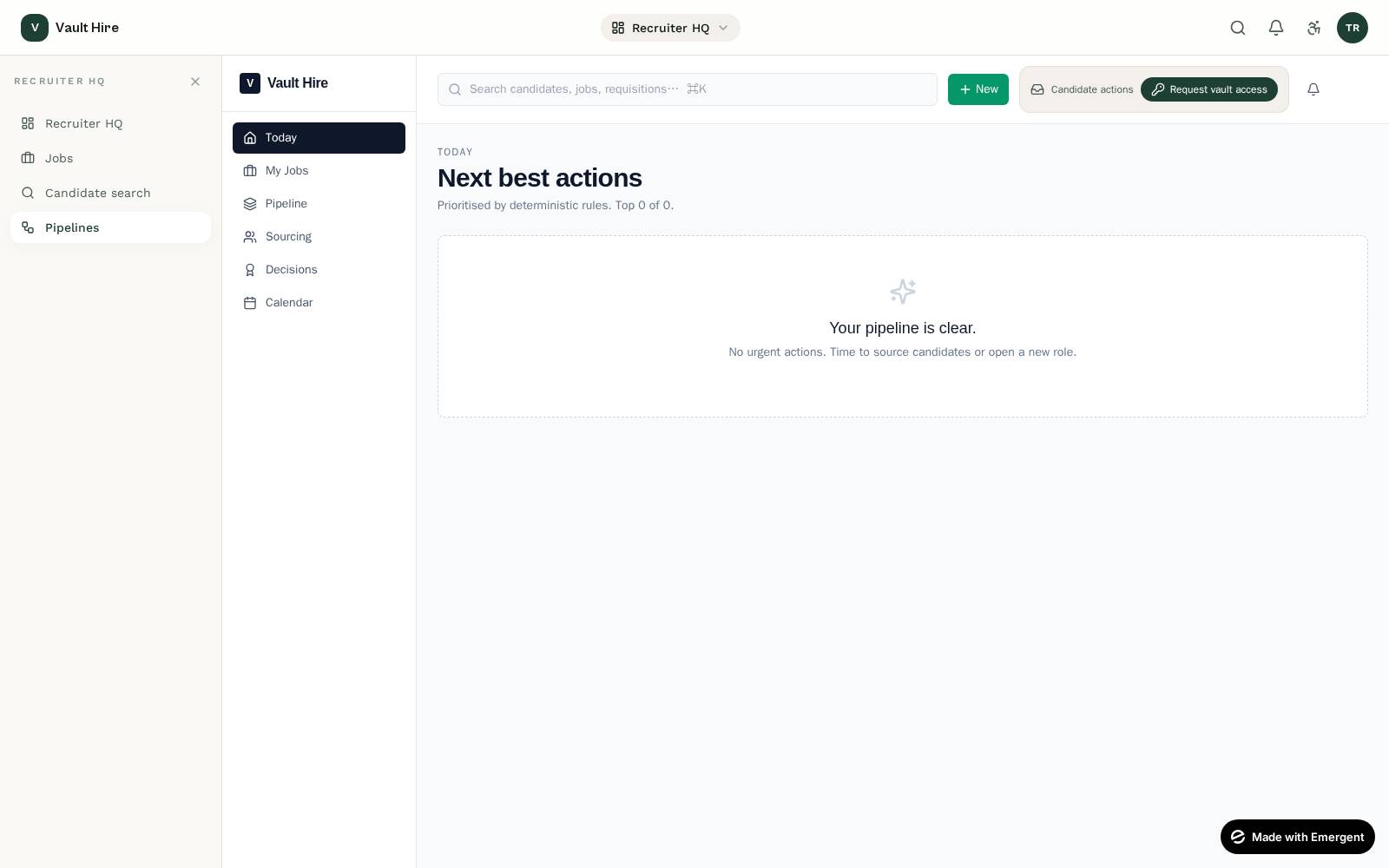
A recruiter requests Sarah's vault. She approves with a couple of clicks. Or — independently — she finds a posted job on Vault Hire's public board and applies.
What this step does
Every share is time-bound, section-scoped, and revocable. The candidate's data only travels when she chooses; the recruiter is never granted blanket access.
Approved AI profile
The platform drafts an AI summary from her verified data. Sarah reads it; she approves it (or edits and re-approves). Once approved, that profile is what recruiters see in their Vault Hubs.
Why she keeps coming back
Approval-required AI is rare in this market. The candidate is never shown by AI without her sign-off; tampering is detectable by content hash. That trust is what makes her invest in keeping the vault current.
References reused
Sarah switches jobs. The next bank asks for a regulatory reference. She doesn't chase her ex-manager — the signed pack from step 4 is already in her vault. One click hands it over.
What this step does
This is the compounding moment — every subsequent move on the platform is dramatically faster than the first. The candidate becomes a Vault Hire champion across employers.
A career-long, candidate-owned record
Sarah switches employer, country, sector — even out of regulated banking entirely. The vault is hers. It moves with her, accumulates signed evidence with every move, and never needs rebuilding.
What this step does
- Sarah's signed regulatory references from HSBC and Barclays are now permanent assets, reusable in any future regulated hire.
- Approved AI profile versions are kept across her career — the diff between v1 and v8 is itself a story for hiring managers.
- Her audit trail spans every recruiter who ever opened her vault — a personal CRM-of-people-who-wanted-to-hire-me, viewable only by her.
Why the candidate stays — and why she's never charged
The economic principle
Candidates never pay for their own data. The platform is monetised by the companies that consume verified data — recruiters at banks pay per active requisition, per pack consumed, or per tenant. Sarah's incentive is to keep her vault current because her next employer reuses what's already verified, not because she'd lose access if she didn't.
This sits at the heart of UK GDPR and the EU AI Act: the data subject (Sarah) cannot be made to pay for control over her own data. By keeping her tier free for life, Vault Hire aligns the commercial model with the regulatory principle — and earns the network effect that makes the recruiter tier valuable in the first place.
For how that recruiter / company tier monetises, see the Recruiter journey.
What this step does
This is the zero-friction entry. Honouring one reference takes ≈ 90 seconds. The platform now has a verified employment record (Sarah's own past role at HSBC) without Sarah having to enter any of it manually.